Delivery of Heavy Steel Structure for a 27,600 sqm Large-Span Industrial Factory in Brunei
1. Market Background
Industrial infrastructure development in Southeast Asian coastal regions, such as the Brunei-Muara District, constantly faces severe challenges from tropical rainforest climates. Characterized by year-round high temperatures, torrential rainfall, and permanent exposure to high-salinity coastal salt spray, local building codes enforce exceptionally high technical compliance standards regarding wind load resistance, anti-corrosion classifications, and structural load-bearing consistency.
2. Client Requirements & Applications
The client for this project is a prominent local building materials manufacturer in Brunei. The structural framing was designed for a massive, automated brick manufacturing plant spanning a total footprint of $120 times 230text{ meters}$ (totaling 27,600 square meters).
-
Operating Conditions: To accommodate heavy high-temperature tunnel kilns and automated setting machines inside the workshop, the building required a large-span layout.
-
Core Challenges: The structural steel framework had to withstand the dual corrosive effects of high-temperature heat dissipation from production lines and an outdoor ISO C4 coastal corrosive environment, all while maintaining absolute spatial stability for overhead crane operations.
3. Our Technical Solution
To engineer a framework capable of enduring Brunei’s high-salinity, high-humidity, and large-span operating conditions, we engineered a custom-designed heavy portal frame system:
-
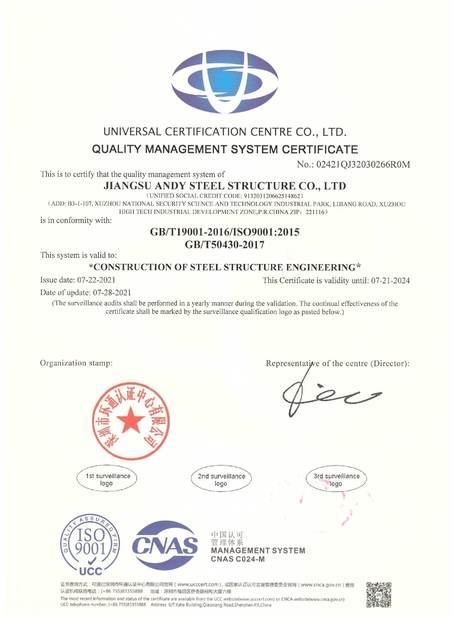
Material & Standards: All primary load-bearing columns and beams utilized high-strength Q355B structural steel, fabricated strictly in adherence to GB/T 1591-2018 standards.
-
Parameterized Anti-Corrosion Configuration: Steel surfaces underwent abrasive blast cleaning to a rigorous Sa2.5 grade. The coating system consisted of a zinc-rich epoxy primer followed by a highly weather-resistant polyurethane topcoat, maintaining a total dry film thickness (DFT) of ≥ 125 µm to safeguard structural stability.
-
Precision Fabrication: Large-span H-beams were manufactured via automated submerged arc welding (SAW). Critical load-bearing connections underwent 100% ultrasonic testing (UT Class 2 or higher welds) to ensure uncompromised structural integrity under extreme wind loads.
4. Delivery & Client Feedback
By executing a strict 1:1 factory pre-assembly inspection of key structural joints, dimensional length tolerances were restricted to within $pm 2text{ mm}$. At the construction site in Brunei, the installation team completed the erection efficiently without requiring on-site cutting or rewelding. The client's Project Director stated: "The structural steel fabricated in China demonstrated exceptional consistency in bolt-hole alignment and rigidity. The anti-corrosion coating remained intact despite marine transit and rainy on-site conditions, securing critical time for our subsequent machinery installation."
5. Conclusion
This project successfully achieved the delivery of a large-span, highly corrosion-resistant industrial plant through rigorous fabrication controls.
-
Key Technical Parameters Summary: Total area: $27,600text{ m}^2$, primary material grade: Q355B, weld inspection: 100% UT, protective coating thickness: ≥ 125 µm.
This case study reinforces that parameterized quality verification is the absolute cornerstone for ensuring the long-term safety and structural reliability of heavy industrial steel framing under challenging overseas environments.


 Your message must be between 20-3,000 characters!
 English